Posts tagged horizons of the possible
I always like to work on leftovers, doing the leftover things. Things that were discarded, that everybody knew was no good, I always thought had a great potential to be funny ... I’m not saying that popular taste is bad and so that what’s left over from the bad taste is good: I’m saying that what’s left over is probably bad, but if you can take it and make it good or at least interesting, then you’re not wasting as much as you would otherwise. ... I deviate from my philosophy of using leftovers in two areas: (1) my pet, and (2) my food.
—The Philosophy of Andy Warhol, p.93–94
 Articles of good design

Nate
:
 Love throws a line
Nate
:
Friedman is locked into reverence for technology, sometimes at the expense of common sense. He conjures up a house so “smart” that its room lights are triggered by motion sensors; a central monitoring device is in constant contact with the local public utility, automatically reducing consumption at peak times; the house generates its own energy from wind and the sun; and “when the sun is shining brightly and the wind is howling” the house’s energy-brain will turn on your dryer, finishing up your laundry.
McKibben asks: “Does it ever occur to him, in the grip of a fantasia like this, that if the sun is shining brightly, or the breeze is blowing steadily, you could dry your clothes on a $14 piece of rope strung off your back deck, or for that matter on a foldable rack in the apartment hallway?” Friedman’s smart house is more benign version of the much-hyped hydrogen car, in other words: They’re both sexy and a long way off, while there are other, simpler solutions already at hand.

Nate
:
The goal of the creators of The Big Chart, The Counter-Intuitive Comparison Institute of North America (CICINA), is to find the single best thing in the world through an NCAA basketball tournament-style bracketing system. This video explains their plans.
“Is the Bilbao Guggenheim better than McDonald’s french fries?Are penguins better than Miracle Grow? Can anything beat heated seats on a cold November day?”
(via design observer)
Rice husk power
Nate
:NextBillion.net: Tell me about rice husk – what is it, how much is there, where do you find them? What do farmers do with them now?
Chip Ransler: Rice husk is the outside of a rice kernel. When you harvest rice, husk represents about 30 percent of the gross weight. As a result, husks are removed and discarded before transport. In a typical village, about 1500 tons of rice are harvested every season, yielding 500 tons of husk and 1000 tons of edible product. The farmers either burn the husk or allow it to rot in the fields.
Rice husk is cellulosic, which means it can be heated up and released for energy – the gas released is similar to methane. It also contains silica, which is released as a waste product when burned.
So, why is this interesting? If you took a map of the world’s energy poor areas and compare it to a map of rice producing areas, these two maps would look nearly identical. So we use husk to make electricity. The gas we make out of the husk is filtered, then run through a diesel-like engine to generate power.
Like I said, farmers throw away or burn rice husk – releasing methane into the atmosphere. This is an opportunity too. We’re working with the Indian government on getting our Clean Development Mechanism certification to sell carbon credits associated with our plants. And the silica – which is the other waste product – is sold to concrete manufacturers. So we take agricultural waste and turn it into electricity, minerals and carbon credits.
Cezanne’s dream team
Nate
:But for Zola, Cézanne would have remained an unhappy banker’s son in Provence; but for Pissarro, he would never have learned how to paint; but for Vollard (at the urging of Pissarro, Renoir, Degas, and Monet), his canvases would have rotted away in some attic; and, but for his father, Cézanne’s long apprenticeship would have been a financial impossibility. That is an extraordinary list of patrons. The first three—Zola, Pissarro, and Vollard—would have been famous even if Cézanne never existed, and the fourth was an unusually gifted entrepreneur who left Cézanne four hundred thousand francs when he died. Cézanne didn’t just have help. He had a dream team in his corner.
This is the final lesson of the late bloomer: his or her success is highly contingent on the efforts of others.
Nate
:Nate
:A hoax hoax
Nate
:The “War of the Worlds” broadcast remains enshrined in collective memory as a vivid illustration of the madness of crowds and the deeply invasive nature of broadcasting. The program seemingly proved that radio could, in the memorable words of Marshall McLuhan, turn “psyche and society into a single echo chamber.” The audience’s reaction clearly illustrated the perils of modernity. At the time, it cemented a growing suspicion that skillful artists — or incendiary demagogues — could use communications technology to capture the consciousness of the nation. It remains the prime example used by media critics, journalists, and professors to prove the power of the media.
Yet the media are not as powerful as most think, and the real story behind “The War of the Worlds” is a bit more complex. The panic was neither as widespread nor as serious as many have believed at the time or since.
Nobody died of fright or was killed in the panic, nor could any suicides be traced to the broadcast. Hospital emergency-room visits did not spike, nor, surprisingly, did calls to the police outside of a select few jurisdictions. The streets were never flooded with a terrified citizenry. Ben Gross, the radio columnist of the New York Daily News, later remembered a “lack of turmoil in front of CBS” that contrasted notably with the crowded, chaotic scene inside the building. Telephone lines in New York City and a few other cities were jammed, as the primitive infrastructure of the era couldn’t handle the load, but it appears that almost all the panic that evening was as ephemeral as the nationwide broadcast itself, and not nearly as widespread. That iconic image of the farmer with a gun, ready to shoot the aliens? It was staged for Life magazine.
Nate
:
In a ritual repeated nearly every weekend for the past decade here in Colombia’s war-weary Caribbean hinterland, Luis Soriano gathered his two donkeys, Alfa and Beto, in front of his home on a recent Saturday afternoon. Sweating already under the unforgiving sun, he strapped pouches with the word “Biblioburro” painted in blue letters to the donkeys’ backs and loaded them with an eclectic cargo of books destined for people living in the small villages beyond. His choices included “Anaconda,” the animal fable by the Uruguayan writer Horacio Quiroga that evokes Kipling’s “Jungle Book”; some Time-Life picture books (on Scandinavia, Japan and the Antilles); and the Dictionary of the Royal Academy of the Spanish Language.
“I started out with 70 books, and now I have a collection of more than 4,800,” said Mr. Soriano, 36, a primary school teacher who lives in a small house here with his wife and three children, with books piled to the ceilings. “This began as a necessity; then it became an obligation; and after that a custom,” he explained, squinting at the hills undulating into the horizon. “Now,” he said, “it is an institution.”
A whimsical riff on the bookmobile, Mr. Soriano’s Biblioburro is a small institution: one man and two donkeys. He created it out of the simple belief that the act of taking books to people who do not have them can somehow improve this impoverished region, and perhaps Colombia.
The afterlife of Gordon Gekko
Nate
:Gekko’s character was written to create an engaging, charming, but deceitful and brutal being. I have nevertheless run into quite a number of younger people, who upon discovering that I co-wrote the film, wax rhapsodic about it . . . but often for the wrong reasons.
A typical example would be a business executive or a younger studio development person spouting something that goes like this: “The movie changed my life. Once I saw it I knew that I wanted to get into such and such business. I wanted to be like Gordon Gekko.”
The flattery is disarming and ego-stoking, but then neurons fire and alarm bells go off. “You have succeeded with this movie, but you’ve also failed. You gave these people hope to become greater asses than they may already be.”
 NY Department of Bridges

Nate
:Nate
:I feel sometimes as if I were a child who opens its eyes on the world once and sees amazing things it will never know any names for and then has to close its eyes again. I know this is all mere apparition compared to what awaits us, but it is only lovelier for that. There is a human beauty to it. And I can’t believe that, when we have all been changed and put on incorruptibility, we will forget our fantastic condition of mortality and impermanence, the great bright dream of procreating and perishing that meant the whole world to us. In eternity this world will be Troy, I believe, and all that has passed here will be the epic of the universe, the ballad they sing in the streets. Because I don’t imagine any reality putting this one in the shade entirely, and I think piety forbids me to try.
 Glamour and grace
Nate
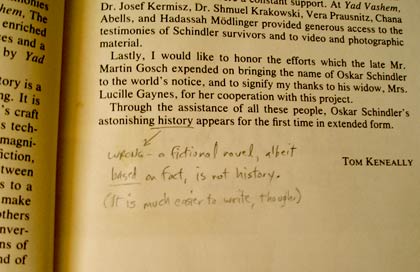
:WRONG—
Nate
:The other Prohibition
Nate
:In 1904, the Anti-Tipping Society of America sprang up in Georgia, and its 100,000 members signed pledges not to tip anyone for a year. Leagues of traveling salesmen opposed the tip, as did most labor unions. In 1909, Washington became the first of six states to pass an anti-tipping law. But tipping persisted. The new laws rarely were enforced, and when they were, they did not hold up in court. By 1926, every anti-tipping law had been repealed.
Nate
:Late in the book, when Kidder begins — and very skillfully too — to draw together the threads of his narrative and to sum up (as best he can) his understanding of Farmer, he notes Farmer’s fondness for a particular phrase: “the long defeat.” At one point Farmer says to Kidder,
“I have fought the long defeat and brought other people on to fight the long defeat, and I’m not going to stop because we keep losing. Now I actually think sometimes we may win. I don’t dislike victory. ... You know, people from our background — like you, like most PIH-ers, like me — we’re used to being on a victory team, and actually what we’re really trying to do in PIH is to make common cause with the losers. Those are two very different things. We want to be on the winning team, but at the risk of turning our backs on the losers, no, it’s not worth it. So you fight the long defeat.”
In an interview Kidder gave earlier this year about the book, he commented on the phrase, and says that Farmer “probably picked [it] up from reading Camus.” But that’s not right: he got it from what we learn in Mountains Beyond Mountains is his favorite book: The Lord of the Rings. Galadriel says it: “Through the ages of the world we have fought the long defeat.” And Tolkien himself, in letters, adopted and endorsed the phrase: “I am a Christian, and indeed a Roman Catholic, so that I do not expect ‘history’ to be anything but a ‘long defeat’ — though it contains (and in a legend may contain more clearly and movingly) some samples or glimpses of final victory.”
It seems to me that this philosophy of history, if we may call it that, is the ideal one for anyone who has exceptionally difficult, frustrating, even agonizing, but nevertheless vitally important work to do. For such people, the expectation of victory can be a terrible thing — it can raise hopes in (relatively) good times only to shatter them when the inevitable downturn comes. Conversely, the one who fights the long defeat can be all the more thankful for victories, even small ones, precisely because (as St. Augustine said about ecstatic religious experiences) he or she does not expect them and is prepared to live without them.
The dignity of plants
Nate
:For years, Swiss scientists have blithely created genetically modified rice, corn and apples. But did they ever stop to consider just how humiliating such experiments may be to plants?
That’s a question they must now ask. Last spring, this small Alpine nation began mandating that geneticists conduct their research without trampling on a plant’s dignity.
“Unfortunately, we have to take it seriously,” Beat Keller, a molecular biologist at the University of Zurich. “It’s one more constraint on doing genetic research.”
Dr. Keller recently sought government permission to do a field trial of genetically modified wheat that has been bred to resist a fungus. He first had to debate the finer points of plant dignity with university ethicists. Then, in a written application to the government, he tried to explain why the planned trial wouldn’t “disturb the vital functions or lifestyle” of the plants. He eventually got the green light.
The rule, based on a constitutional amendment, came into being after the Swiss Parliament asked a panel of philosophers, lawyers, geneticists and theologians to establish the meaning of flora’s dignity.
“We couldn’t start laughing and tell the government we’re not going to do anything about it,” says Markus Schefer, a member of the ethics panel and a professor of law at the University of Basel. “The constitution requires it.”
In April, the team published a 22-page treatise on “the moral consideration of plants for their own sake.” It stated that vegetation has an inherent value and that it is immoral to arbitrarily harm plants by, say, “decapitation of wildflowers at the roadside without rational reason.”
On the question of genetic modification, most of the panel argued that the dignity of plants could be safeguarded “as long as their independence, i.e., reproductive ability and adaptive ability, are ensured.” In other words: It’s wrong to genetically alter a plant and render it sterile.
Nate
:I watch Grey’s Anatomy for the fast-paced gore and the overblown personal dramas. I watch its spin-off, Private Practice, for all that along with its thoughtful treatment of bioethical dramas – the same dramas we’re seeing in real-life hospitals and public debate.
The bioethics debate isn’t just a clinical and scientific debate or an abstract and philosophical one. It’s a debate about how to best fulfill the human longings for long life, good life, health and family. There’s all sorts of humanity mixed up in it - competing human longings and fallible human judgment deciding human life’s creation and existence. While philosophers and politicians squabble, doctors practice bioethics every day; and they don’t always have the time for debate when human life is at stake and the ethical choice isn’t clear.
Stone wall, Cuzco, Peru

Nate
: